

4. Art room
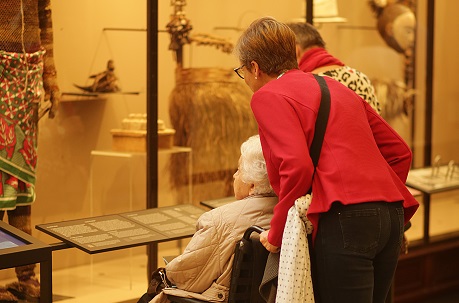
The art gallery was renewed in 2006. The objects are merely approached aesthetically in an attractive and modern museography. Here you can find some absolute top pieces of the museum’s collection.
Luba mask
This mask is probably the best-known item of our ethnographic collection due to its mysterious beauty. Even though it symbolises the art of the LUBA from the south-eastern province of Shaba and African art in general, little is known about this impressive mask.
Few anthropologists or ethnologists did any fieldwork during the first half of the 20th century. Soldiers, missionaries and colonial officers were assigned to collect objects for the museum. These objects were mostly not provided with any documentation.
There are many hypotheses about the origin and meanings of this mask. The bird at the back of the mask and the buffalo horns are related to the Luba chief’s supernatural characteristics.
Kifwebe mask
The mask comes from the SONGYE and has strong geometric features and linear incised surfaces. The mask was used in combination with a straw and raffia costume as part of rituals, to ward off disasters and threats and during the inauguration or death of a chief. The male masks can generally be recognised by their red, white and black stripes on a grooved surface, the female ones mainly have white features that are highlighted in red or black.
This mask still shows traces of the accompanying costume. The costume is an integral part of the masks as the dancers need to be unrecognisable. Both face and body are fully covered. Unfortunately, the original costumes were seldom preserved.

Yaka mask
The YAKA live on the border of southwest Congo and northern Angola.
Their masks are part of the circumcision and puberty rituals for boys.
The wooden masks display a sculpture in the shape of a human face with a long, hanging raffia hairstyle, sometimes crowned by an animal or an erotic character. The upright nose of this version can be literally read as a phallic symbol.
Through rhythmic, ritual initiation dances, masked dancers identify themselves with their ancestors and their vitality. Mask traditions continue to play a meaningful role in many African communities.


UNCENSORED. Vivid tales from behind the scenes